
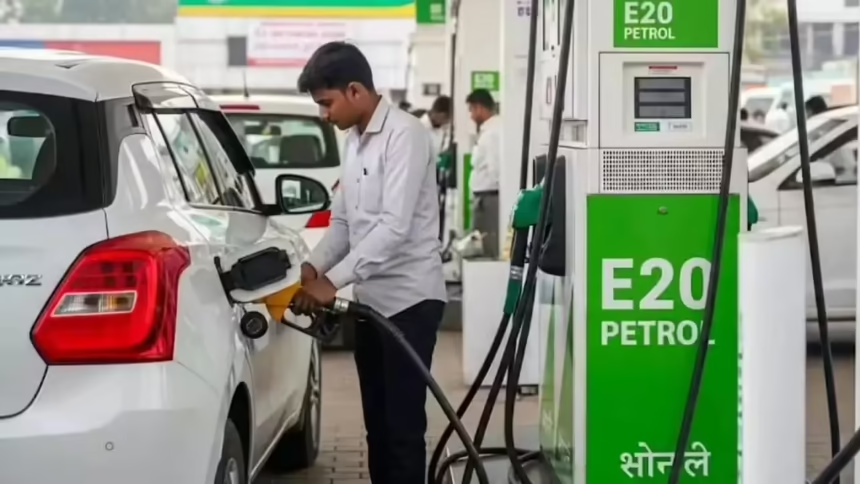
The Union Government has dismissed a series of viral social media claims regarding E20 fuel, asserting that India’s Ethanol Blending Programme (EBP) is scientifically validated, safe for consumers and beneficial for the economy.
In a statement, the Ministry of Petroleum and Natural Gas said several misleading and unsubstantiated allegations were being circulated online, including claims that ethanol-blended petrol could damage vehicle engines or affect insurance coverage.
The ministry said these concerns had been examined in consultation with relevant stakeholders and found to be incorrect.
No Evidence of Widespread Vehicle Damage
According to the ministry, no widespread incidents of engine failure or vehicle breakdown linked to E20 fuel have been reported since its introduction.
Officials stated that the programme is implemented in coordination with automobile manufacturers, oil marketing companies and fuel-testing agencies to ensure compatibility and safety standards are maintained.
The government reiterated that ethanol blending continues to be closely monitored and reviewed.
Also Read – India Rejects Pakistan’s Remarks on Jammu and Kashmir at UN, Reiterates Internal Matter Position
Ministry Rejects Claims Linking E20 Fuel to Insects
The ministry also addressed viral posts claiming that E20 fuel attracts insects or that sugarcane juice is directly mixed with petrol.
Officials clarified that fuel-grade ethanol is produced through industrial fermentation and distillation processes and undergoes stringent quality checks before being blended with petrol.
Referring to a widely circulated video showing ants near a vehicle fuel tank, the ministry cited a clarification from Bharat Petroleum Corporation Limited (BPCL), which stated that fuel ethanol contains no residual sugar and includes denaturants that are repellent to insects.
As a result, claims that E20 fuel attracts ants or other insects have no scientific basis, the ministry said.
Economic and Environmental Benefits Highlighted
The government emphasised that ethanol blending has delivered significant economic benefits by reducing dependence on imported crude oil.
According to the ministry, the programme has helped save more than ₹1.4 lakh crore in foreign exchange through lower crude oil imports.
Officials added that the initiative has created additional demand for agricultural feedstocks such as sugarcane, maize and rice, providing support to farmers and strengthening rural incomes.
Also Read – SIT Recommends Administrative Overhaul in Ram Temple Donation Probe, Suggests CEO Appointment
Global Practice and Long-Term Strategy
The ministry noted that ethanol blending is widely adopted across several countries, including the United States, Brazil and Japan.
Brazil, in particular, has successfully implemented higher ethanol blending levels for many years, with E27 serving as its standard petrol blend.
Reaffirming its commitment to the Ethanol Blending Programme, the government said the initiative contributes to reducing carbon emissions, improving energy security and advancing India’s transition toward cleaner mobility solutions.
Launched in 2003, the programme remains a key component of India’s broader strategy to promote sustainable and cleaner transportation fuels.