
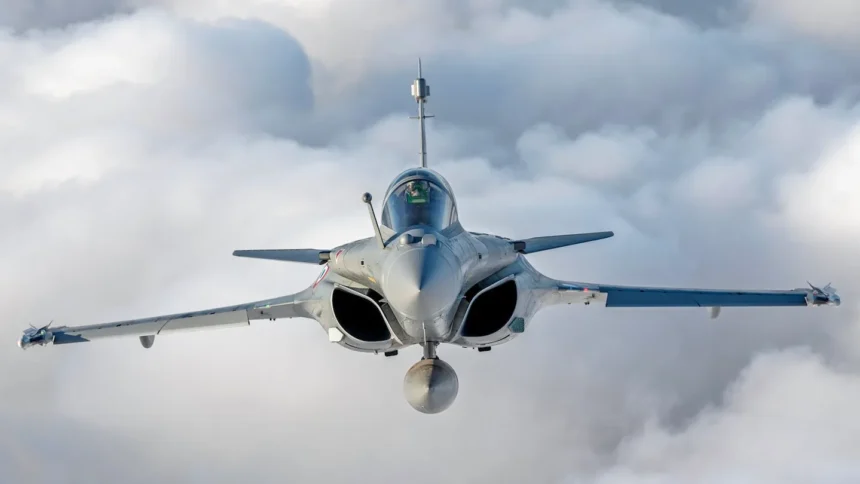
A United States congressional advisory body has accused China of conducting an artificial-intelligence-driven disinformation campaign aimed at undermining India’s military reputation and the global image of the French Rafale fighter jet following Operation Sindoor.
In its latest annual report, the US-China Economic and Security Review Commission claimed Beijing used fake social media accounts to circulate AI-generated images falsely depicting debris of Indian and French aircraft allegedly destroyed by Chinese systems.
Objective: Undermine Rafale, Promote China’s J-35 Fighter
The Commission alleged that China’s campaign sought to damage the international defence market prospects of the Rafale jet while promoting its own next-generation J-35 aircraft. The narrative was portrayed as part of Beijing’s broader “Grey Zone” strategy—tactics designed to influence geopolitical outcomes without conventional military confrontation.
According to the report, China “opportunistically” exploited the India-Pakistan hostilities in May to highlight the supposed superiority of Chinese weaponry and reinforce its position amid ongoing tensions along the India-China border.
Also Read – PM Modi Says ‘Winds of Bihar Have Reached Tamil Nadu’ During Coimbatore Address
Operation Sindoor: India’s Military Response to Pahalgam Attack
Operation Sindoor was launched in May following the Pahalgam terror attack in April that killed 26 civilians. During the operation, the Indian Air Force targeted terror infrastructure and military assets inside Pakistan.
In August, Air Chief Marshal A.P. Singh confirmed that Indian forces destroyed five Pakistani fighter jets and a major airborne surveillance aircraft—significantly boosting India’s strategic confidence.
India-China Relations: Report Points to Asymmetry in Approach
The Commission highlighted a fundamental asymmetry in how India and China view the resolution of border disputes.
- China, it noted, uses high-level diplomacy to obtain partial outcomes while trying to separate the boundary issue from broader economic engagement.
- India, in contrast, insists that genuine normalisation of ties cannot occur without meaningful progress on the border question.
The report criticised the lack of concrete movement, stating that recent agreements remain “conceptual” with limited practical follow-through.
Also Read – Nitish Kumar Elected NDA Leader in Bihar, Set to Take Oath as Chief Minister for 10th Time
Dalai Lama Succession Seen as Potential Flashpoint
The report also warned that the future succession of the Dalai Lama could emerge as a significant trigger for heightened India-China tensions.
India’s Diplomatic Hedging and US-India Ties
It suggested that Prime Minister Narendra Modi’s meeting with Chinese President Xi Jinping at the SCO Summit may be part of New Delhi’s attempt to hedge amid fluctuating talks with Washington—particularly after the US imposed a 50% tariff on Indian goods earlier this year.
Despite trade frictions, the report noted that India-US ties have begun stabilising, with the first phase of a new trade agreement expected soon.