
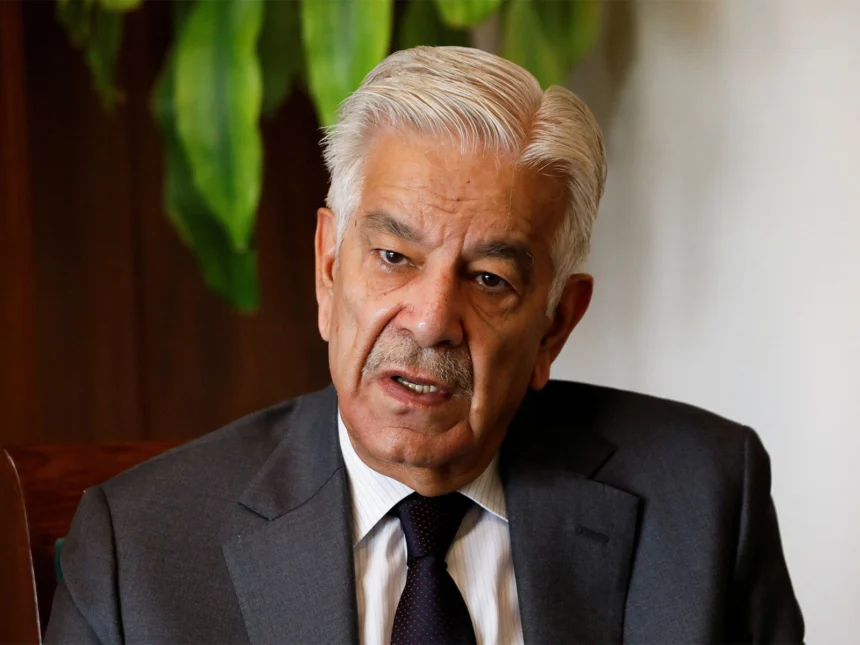
Pakistan’s Defence Minister Khawaja Asif on Wednesday declared that the country was “in a state of war”, warning Afghanistan of potential cross-border military action after a devastating suicide bombing in the capital killed at least 12 people.
The powerful statement came hours after the Tehrik-i-Taliban Pakistan (TTP) claimed responsibility for the explosion outside a district court in Islamabad’s G-11 sector, marking one of the deadliest attacks in the city in recent years.
‘Acts Planned from Afghan Soil Will Be Answered in Kind’
Speaking to reporters following an emergency security review, Asif accused the Afghan Taliban regime of providing safe havens to militant groups operating against Pakistan.
“If acts of terrorism are being planned and executed from Afghan soil, they will have to be answered in the same coin,” he said, signalling that retaliatory cross-border strikes were now under consideration.
Also Read – Over 4,300 Stubble Burning Incidents in Punjab, Haryana Since September, Supreme Court Seeks Detailed Report
He further stated, “Pakistan has exercised restraint for far too long. If our neighbour continues to turn a blind eye, targeted action across the border is inevitable.”
National Security Committee Convenes Emergency Meeting
In response to the attack, Asif chaired an emergency session of the National Security Committee (NSC), describing the bombing as “a wake-up call for the entire nation.”
He said the attack exposed deep vulnerabilities in Pakistan’s counterterrorism framework and warned that tolerance for Kabul’s “inaction” against militant sanctuaries had “reached its limit.”
Officials confirmed that the explosion was caused by a car packed with explosives parked near the district court’s parking area. The blast was reportedly timed to cause maximum casualties, leaving at least 12 dead and dozens injured.
Tensions Rise Between Islamabad and Kabul
Relations between Pakistan and Afghanistan have deteriorated sharply since the Taliban’s takeover of Kabul in 2021.
Islamabad has long accused the Afghan regime of harbouring TTP fighters, who have regrouped and intensified attacks inside Pakistan over the past two years.
Kabul, however, has repeatedly denied these accusations, urging Pakistan to resolve differences through dialogue rather than military confrontation.
Also Read – Arjun Tendulkar Likely to Join Lucknow Super Giants, Shardul Thakur to Return to Mumbai Indians
Nation on High Alert; Militants Traced to Afghan Provinces
Following the bombing, Pakistan’s Interior Ministry placed major cities on high alert and tightened surveillance along the Durand Line, the border dividing the two nations.
Intelligence officials revealed that militant communication channels linked to the attack were traced to Afghanistan’s Kunar and Nangarhar provinces.
Asif concluded by warning that the attack marked a “national security red line” for Pakistan.
“We cannot afford to let anyone exploit our borders again,” he said. “This is now a fight for Pakistan’s survival.”