
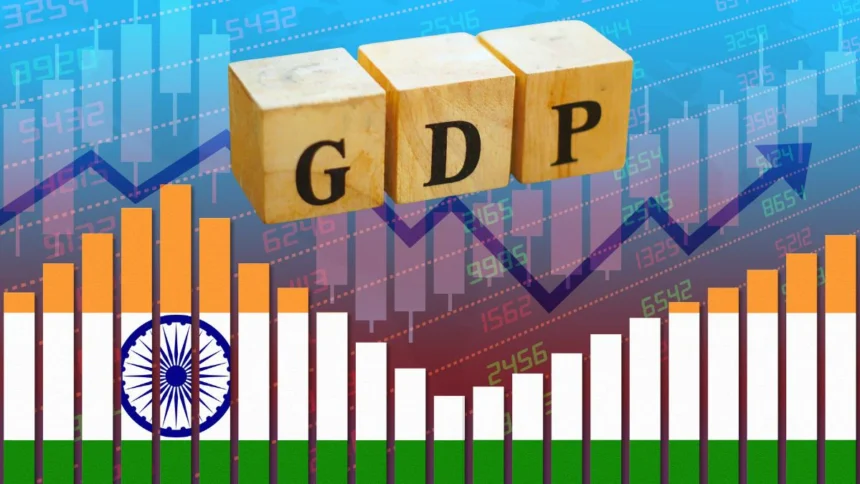
The World Bank has revised India’s Gross Domestic Product (GDP) growth forecast for FY26 upward to 6.5% from its earlier projection of 6.3%, citing resilient domestic demand, a strong rural recovery, and the positive impact of GST 2.0 reforms. The report highlights that India is expected to remain the world’s fastest-growing major economy, driven largely by domestic consumption.
“Domestic conditions, particularly agricultural output and rural wage growth, have been better than expected. The government’s reforms to the Goods and Services Tax (GST)—reducing tax brackets and simplifying compliance—are expected to support economic activity,” the World Bank stated in its South Asia Development Update.
However, the World Bank cautioned that India’s growth in FY27 could be impacted by higher U.S. tariffs on Indian exports. Nearly 20% of India’s goods exports go to the U.S., accounting for about 2% of GDP. The report noted that India initially faced lower tariffs, but by August 2025, it was subject to significantly higher duties.
India’s GDP performance has been exceptionally strong. In Q1 FY26, the economy grew 7.8%, surpassing analysts’ expectations of 6.5-7%. The real GDP in Q1 FY26 is estimated at Rs 47.89 lakh crore, up from Rs 44.42 lakh crore in Q1 FY25. Nominal GDP, which factors in inflation, rose by 8.8%.
GST 2.0 Reforms
In a landmark reform effective September 22, 2025, the GST Council simplified tax slabs to 5% and 18%, with a special 40% slab for luxury and sin goods. Essential household items such as toothpaste, shampoo, hair oil, soaps, and utensils now attract only 5% GST, aimed at reducing the cost of living and boosting consumption.
U.S. Tariff Impact
The United States imposed a 50% tariff on Indian goods from August 27, 2025, adding a second 25% duty on top of an earlier 25% hike. This is part of U.S. measures targeting countries trading with Russia, with India being a key buyer of Russian crude. The move has drawn condemnation from New Delhi, while Moscow has supported India’s right to choose trade partners.
The World Bank report underscores that strong domestic demand, rural recovery, and structural reforms will continue to support India’s economic growth, though external trade tensions could moderate gains in the coming fiscal year.