
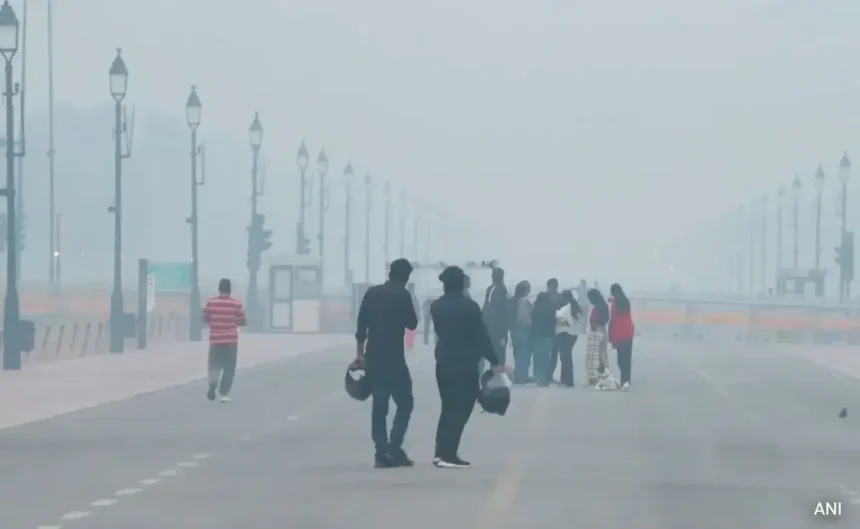
As Delhi woke up to Diwali morning, air pollution levels across the National Capital Region (NCR) worsened sharply, prompting the Commission for Air Quality Management (CAQM) to enforce Stage II of the Graded Response Action Plan (GRAP) on Sunday.
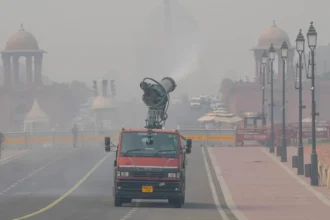
According to the Central Pollution Control Board (CPCB), the Air Quality Index (AQI) around India Gate stood at 347 on Monday morning, placing it in the “very poor” category. Several monitoring stations, including Anand Vihar (411), Punjabi Bagh (383), and Bawana (368), also reported alarming levels.
Delhi’s Air Quality Deteriorates Rapidly
At 8:00 am, AQI readings across the city reflected severe pollution: Sirifort (362), JLN Stadium (355), Alipur (319), and Ayanagar (305). Even the relatively cleaner IGI Airport station recorded 297, nearing the “very poor” threshold.
On Sunday evening, Delhi’s average AQI had risen from 296 at 4:00 pm to 302 by 7:00 pm, with 12 of 38 monitoring stations reporting “very poor” air.
Neighbouring cities Noida and Ghaziabad also fell into the “very poor” bracket, while Faridabad remained “moderate.”
Also Read – Trump Renews Warning Of ‘Massive Tariffs’ On India Over Russian Oil Imports
What Is GRAP And Why It Matters
The Graded Response Action Plan (GRAP) is an emergency framework designed to tackle Delhi’s recurring winter air pollution crisis. It is triggered automatically when pollution levels cross specific AQI thresholds.
The framework operates in four escalating stages:
- Stage I: Poor (AQI 201–300)
- Stage II: Very Poor (AQI 301–400)
- Stage III: Severe (AQI 401–450)
- Stage IV: Severe Plus (AQI above 450)
Each stage imposes progressively stricter curbs to control emissions and dust levels across NCR.
What Changes Under Stage II
With Stage II now in force, CAQM has activated a 12-point action plan, building on Stage I measures. These include:
- Daily mechanical road sweeping and water sprinkling in pollution hotspots
- Strict dust control and inspection at construction sites
- Ban on diesel generator (DG) sets except for essential services such as hospitals and Metros
- Deployment of additional traffic personnel to ease congestion
- Public advisories through media with do’s and don’ts
- Higher parking fees to discourage private vehicle use
- Increased frequency of Metro trains and CNG/electric buses
- Ban on coal and firewood use in hotels, restaurants, and eateries
- Resident Welfare Associations (RWAs) to provide electric heaters for guards to prevent biomass burning
Only electric, CNG, or BS-VI diesel buses are allowed entry into Delhi.
Also Read – Ayodhya’s Deepotsav Sets Guinness World Record with 26 Lakh Diyas Across 56 Ghats
Citizens Urged To Cooperate
The Environment Ministry has urged citizens to reduce the use of private vehicles, opt for public transport, avoid open burning, and follow the Citizen Charter guidelines for Stages I and II.
The ministry emphasized collective responsibility, stating that compliance from citizens and local bodies is critical to improving Delhi’s air quality.
Next Step: Stage III If AQI Crosses 400
If Delhi’s average AQI breaches 400, Stage III measures will be activated, including:
- Complete ban on construction and demolition activities
- Suspension of operations at brick kilns and stone crushers
- Ban on entry of diesel-powered medium and heavy vehicles into Delhi
Authorities continue to monitor pollution levels closely, warning that further restrictions could be imposed without delay if conditions worsen.