
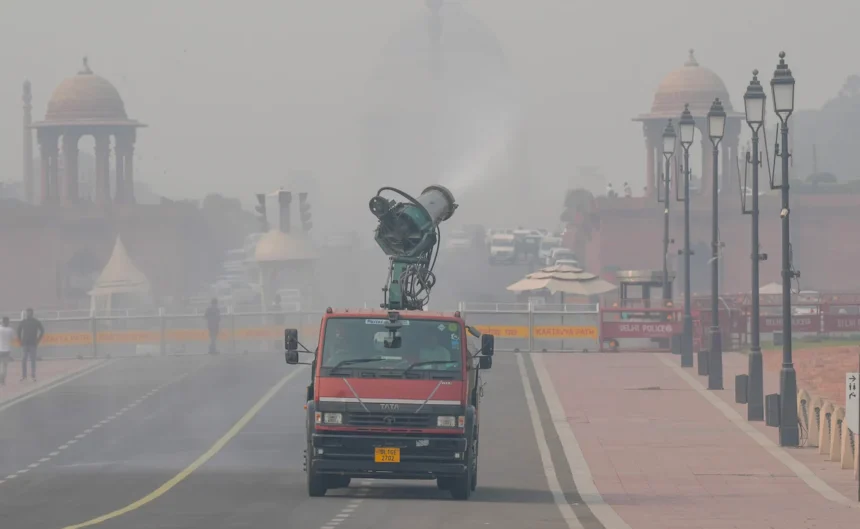
Delhi woke up to another day of toxic smog on Wednesday, with the Air Quality Index (AQI) hovering in the ‘Very Poor’ category across most monitoring stations. According to the Central Pollution Control Board (CPCB), the AQI around Akshardham touched 360, reflecting worsening pollution levels.
Pollution Levels Continue to Rise
Data recorded at 6:15 AM showed alarming AQI readings across the city: Ashok Vihar, Bawana, and Dilshad Garden registered values around 380, while stations such as IGI Airport, DTU, and Lodhi Road reported slightly lower readings in the “Poor” range, below 300.
Experts have attributed the pollution spike to a mix of stubble burning, vehicular emissions, and stagnant weather conditions that are preventing the dispersion of pollutants.
Also Read – Udhayanidhi Stalin’s ‘For Those With Faith’ Diwali Wish Sparks BJP Backlash
Health professionals have urged residents — especially children, the elderly, and those with respiratory conditions — to stay indoors and avoid prolonged outdoor exposure.
Chief Minister’s Statement: ‘Working Proactively on Artificial Rain’
Delhi Chief Minister Rekha Gupta on Wednesday said her government is working “proactively” on plans to induce artificial rain to bring down pollution levels in the capital.
The initiative will be launched once the India Meteorological Department (IMD) confirms the presence of adequate cloud and moisture conditions, the Chief Minister’s Office said.
Highlighting the state’s focus on sustainable mobility, Gupta added, “Our target is to deploy 10,000 electric buses by 2027.”
She said the government is expanding public and semi-public EV charging stations to improve infrastructure and reduce vehicular pollution.
GRAP Stage II Measures Continue Across NCR
With air quality deteriorating, the Commission for Air Quality Management (CAQM) has continued enforcement of Stage II of the Graded Response Action Plan (GRAP), which was activated on October 19.
The ongoing measures include:
- Daily mechanical and vacuum sweeping of major roads.
- Water sprinkling with dust suppressants in high-traffic zones.
- Stricter inspections at construction and demolition sites.
- Increased parking fees to discourage private vehicle use.
- Boosted public transport frequency and uninterrupted electricity supply to reduce use of diesel generators.
The CAQM, in an official statement, instructed civic bodies to ensure regular dust suppression and proper disposal of collected debris.
“Water sprinkling along with dust suppressants should be carried out at least every alternate day, especially in vulnerable and high-traffic areas,” it said.