
Congress Leader Refuses Apology
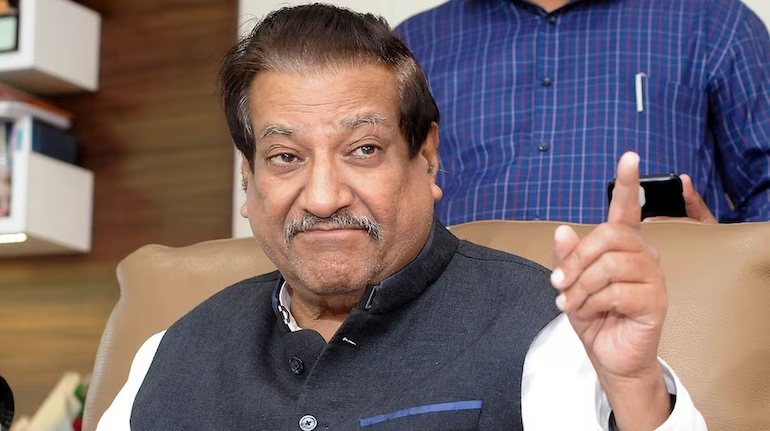
A day after his comments on Operation Sindoor triggered political controversy, senior Congress leader and former Maharashtra Chief Minister Prithviraj Chavan on Wednesday refused to apologise, asserting his right to seek answers.
“I have the right to ask questions. Why should I apologise?” Chavan said, while demanding a fair inquiry into the events at Pahalgam on April 22 and the details surrounding Operation Sindoor.
Alleges Diversion From Parliamentary Issues
Chavan claimed his remarks were being misrepresented to divert public attention from the nuclear privatisation bill, known as the SHANTI Bill, which was introduced in the Lok Sabha on Monday.
He said the focus should instead be on transparency and accountability regarding national security decisions.
Also Read – IPL 2026 Mini Auction: CSK Hand Sarfaraz Khan a Lifeline After Domestic Form Surge
BJP Hits Back
The Bharatiya Janata Party (BJP) sharply criticised Chavan’s statements. BJP IT Cell head Amit Malviya, in a post on X, accused Congress leaders of echoing narratives favourable to Pakistan.
“Why do Congress leaders, without exception, end up speaking the language of Pakistan?” Malviya wrote.
What Triggered the Controversy
The controversy erupted after Chavan claimed that India had suffered setbacks during the initial phase of Operation Sindoor. Addressing a press conference in Pune, he alleged that Indian aircraft were shot down during the four-day conflict.
“On the first day, we were completely defeated. In the aerial engagement that took place, Indian aircraft were shot down,” Chavan said, adding that the Indian Air Force remained grounded due to the perceived risk.
Also Read – IPL 2026 Mini Auction: CSK Signs Young Spinner Prashant Veer for ₹14.2 Crore
Remarks on Future Warfare
Chavan also questioned the relevance of maintaining large ground forces, arguing that modern conflicts are increasingly dominated by aerial and missile warfare.
“In Operation Sindoor, there was hardly any movement of ground forces. Future wars will be fought in the air. In such a situation, do we need to maintain an army of 12 lakh soldiers?” he asked.