
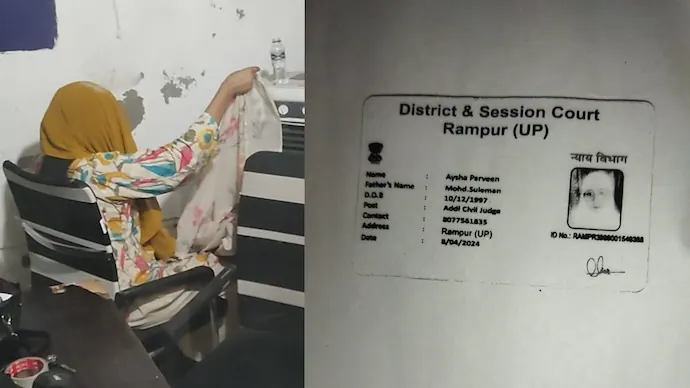
A woman posing as a judicial officer was arrested in Uttar Pradesh’s Bijnor district on Friday after attempting to obtain a ₹35 lakh loan from HDFC Bank using forged documents. Police also arrested a local lawyer who assisted her in the process. Both have been booked and sent to jail.
According to police, the accused, identified as Ayesha Parveen, had submitted a loan application at HDFC Bank’s Civil Lines branch, introducing herself as a judicial officer posted in Rampur. A Bijnor-based lawyer, Anas, who claimed to be a public prosecutor, verified her credentials.
Also Read – Jharkhand Court Sentences 60-Year-Old Woman to Life Imprisonment for Burning Daughter-in-Law Alive
The bank initially processed the application but grew suspicious during verification. Ayesha arrived at the branch in a Baleno car bearing a judge’s insignia and a nameplate identifying her as a judicial officer. Upon rechecking, the bank found that the Axis Bank account statement she had submitted was falsified. While she claimed a monthly salary of ₹1.3 lakh and deposits worth ₹5 lakh, the account actually contained only ₹40,000 and no salary credits. Her identity card, joining letter, and other documents were also confirmed to be fake.
The bank alerted the police, who detained Ayesha and Anas for questioning. A cybercrime team later verified that all documents were forged.
During interrogation, police discovered that Ayesha lived in Judge Colony, Rampur, and used a vehicle with judicial insignia operated by a local taxi driver. The driver told police he was unaware of her impersonation.
Also Read – Bihar Polls 2025: BJP Blames Rahul Gandhi, Tejashwi Yadav for JMM Quitting Mahagathbandhan
Assistant Superintendent of Police Gautam Rai said, “The woman had come to HDFC Bank to obtain a ₹35 lakh loan by posing as a judicial officer. Upon verification, her documents were found to be forged. A case has been registered, and further investigation is underway.”
A case has been lodged against Ayesha Parveen and Anas under relevant sections of fraud, forgery, and impersonation based on the bank’s complaint.