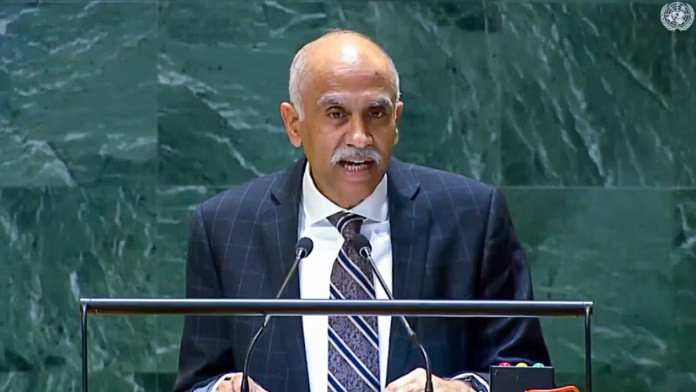

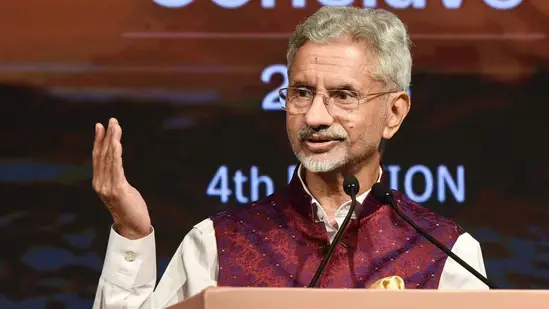
External Affairs Minister S. Jaishankar on Sunday underscored the growing impact of US-China relations on global politics, cautioning that the world is witnessing an era of heightened competition and risk in international affairs.
Speaking at the 4th Kautilya Economic Conclave in New Delhi, Jaishankar said that the balance of global power is being redefined by how Washington and Beijing interact.
“Clearly, what we can see is that the US-China relationships, in many ways, are going to influence the direction of global politics,” he stated.
US and China: Two Diverging Paths of Power
Jaishankar described how both powers are reshaping their global approaches.
“In the case of the United States, it is not only more assertive, but has encouraged its national interest goals to drive its partnerships and cooperation,” he said.
On China, he noted that the country is undergoing a transition phase.
“This change perhaps catches China at a time when many of the new concepts, mechanisms, and institutions it was promoting are not yet in place,” Jaishankar observed.
Europe’s Strategic Shift
Jaishankar also reflected on the altered global equations involving Europe, the US, Russia, and China.
“What was once a sweet spot — US for security, Russia for energy, and China for trade — has now turned into a challenge for Europe,” he remarked.
Changing Global Energy Dynamics
The minister highlighted a major transformation in the energy landscape.
“The United States, which once worried about dependence on foreign energy, is now self-sufficient and a major exporter, making energy exports a part of its strategic outlook,” he said.
At the same time, China has emerged as a leader in renewable energy.
“Any path you take on renewables eventually leads back to China,” Jaishankar added.
Global Powers and the Erosion of Balance
Jaishankar emphasized that many major powers today believe less in the concept of balance of power.
“They seem to think they may not need the rest of the world as much as before. If they have margins of power, they are prepared to use them in pursuit of their policies,” he said.
He cautioned that the world has shifted towards greater competition and the weaponisation of tools of influence.
“The global needle is moving because there is today a tendency to weaponise almost everything,” Jaishankar warned.
‘Paradox of Risk and De-Risking’ in Global Economy
Discussing the state of the global economy, Jaishankar described a paradoxical environment marked by simultaneous risk-taking and risk-avoidance.
“The intensity of multiple developments converging on the global economy has created a paradox where the same factors that encourage higher risk-taking are also leading to efforts to de-risk politics and economics,” he explained.
Concluding his remarks with a striking metaphor, he said:
“It is almost like raising the height of the trapeze while removing the safety net with each passing day. That is the state of international polity today.”