
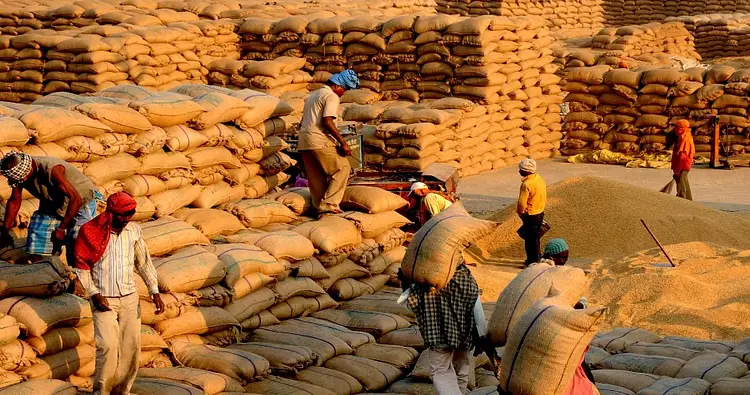
With India’s food grain output touching an all-time high of 353.96 million tonnes in 2024-25, the government has stepped up efforts to expand storage infrastructure to curb post-harvest losses, strengthen the supply chain, and improve farmers’ income.
Current Storage Landscape
According to an official statement, the Food Corporation of India (FCI) and state agencies currently maintain 917.83 lakh metric tonnes of covered and CAP storage capacity for central pool grains. Additionally, the country has 8,815 cold storages with a combined capacity of 40.21 million metric tonnes to safeguard perishable produce.
Decentralised storage is also expanding, with 5,937 new Primary Agricultural Credit Societies (PACS) registered and 73,492 computerised as of June 2025. To further boost efficiency, the Centre has cleared a ₹2,516 crore project for complete PACS computerisation.
Why Storage Matters
Effective warehousing and cold-chain systems play a crucial role in reducing wastage, maintaining buffer stocks, and stabilising food prices. The government stressed that storage capacity directly impacts national food security, helping sustain schemes like the National Food Security Act (NFSA) while shielding consumers from sharp price fluctuations.
Flagship Schemes Driving Expansion
Several government schemes are supporting this expansion drive:
- Agriculture Infrastructure Fund (AIF): Launched in 2020, it provides subsidised loans and credit guarantees for post-harvest projects. As of Sept 2025, ₹73,155 crore has been sanctioned for 1.27 lakh projects, including thousands of warehouses and cold stores, with an overall project cost of ₹1.17 lakh crore.
- Agricultural Marketing Infrastructure (AMI): A component of ISAM, it aims to strengthen godowns and warehouses in rural India. By June 2025, 49,796 projects across 27 states had been approved, creating 982.94 lakh MT of capacity with subsidies worth ₹4,829.37 crore.
- Pradhan Mantri Kisan SAMPADA Yojana (PMKSY): Focused on food processing and value addition, the scheme has approved 1,601 projects to date, of which 1,133 are operational, adding 255.66 lakh MT per year in preservation capacity.
- World’s Largest Grain Storage Plan: Cleared in May 2023, this ambitious cooperative sector initiative aims to set up storage and agri-infrastructure at PACS level, including godowns, custom hiring centres, processing units, and fair price shops.
Linking Farms to Markets
Officials underlined that improved storage and logistics would empower farmers to sell produce at better prices, minimise dependency on intermediaries, and ensure faster access to wider markets. “With record production and modern storage, India is strengthening its food security architecture while moving closer to the vision of Atmanirbhar Bharat,” the statement said.